Technical Study Series · No. 01
Building on what's already there.
A study in preconstruction & due diligence
Detroit turned a generation of ruin into the most valuable ground in the city. The secret to building on what's already there was never the architecture alone. It was preconstruction, and the specialist teams built for the hardest projects in America.
01 — Detroit
The city that turned ruin
into a blueprint.
For thirty years, Detroit was the picture editors reached for when they needed to show American decline. The image was almost always the same one: Michigan Central Station, eighteen stories of Beaux-Arts limestone standing roofless and looted on the edge of Corktown, its windows gone, its marble stripped, weeds pushing out of the cornices. It became the most photographed ruin in the country, a building so synonymous with loss that people flew in to shoot it.
In June of 2024 the same building reopened, and the photograph inverted. The Grand Hall was whole again, the Guastavino tile relaid by hand, the limestone that had crumbled recarved from the same quarries, the concourse full of people for the first time since 1988. Ford had bought the wreck in 2018 and spent roughly a billion dollars and six years turning it into the anchor of Michigan Central, a thirty-acre innovation district. The ruin that had defined the city's fall became the clearest symbol of its return. That reversal is the whole story, and Detroit is where it is written largest.

— The Bedrock effect
One station did not do this.
A whole downtown did.
What makes Detroit the subject, and not just a good example, is that the station was never alone. Block by block, the core came back at the same time.
For more than a decade, Dan Gilbert's Bedrock has been doing something almost no other owner in America has done at this density: buying the great, empty, early-twentieth-century buildings of a downtown and bringing them back, one after another, as mixed-use. Not gut jobs that keep a facade and throw away the building behind it, but restorations that treat the original as the point. The Book Tower, Louis Kamper's 1926 skyscraper, came back in 2023 after a seven-year, roughly $300 million restoration, its glass-domed rotunda cleaned to the light and a hotel, apartments and restaurants slipped inside. The Shinola Hotel wove several historic buildings on Woodward Avenue into a single hospitality block, with Parker's Alley reopened as a lane of shops behind it. The David Whitney Building, the Metropolitan, the Element, the Griswold: the list runs on, and keeps running.
The thread through all of it is respect. These buildings were not scraped clean and made generic. The ornament was conserved, the rotundas and lobbies and terra-cotta were treated as assets rather than obstacles, and the modern program, hotel rooms, apartments, offices, food, was fitted into the old fabric rather than the other way around. The result is a downtown where the most sought-after square footage is the oldest, because character at this level cannot be built new, only kept. Detroit's lesson is not that you can save an old building. It is that the saved building becomes the best one in the city.

Detroit, the firms behind the revival
Quinn Evans →Preservation architects behind much of the city's landmark restoration.
Kraemer Design Group →Book Tower and a deep roster of Bedrock restorations; tax-credit specialists.
SmithGroup →Detroit-founded; large-scale civic, campus and riverfront work.
Hamilton Anderson Associates →Architecture and planning across the city's neighborhoods and waterfront.
1913
Michigan Central opens. It closes in 1988 and stands empty for 30 years.
~$1B
Ford's investment to bring the station and its Corktown district back.
$300M
Bedrock's seven-year restoration of the Book Tower, one building among many.
90+
Properties Bedrock has assembled downtown, much of it historic reuse.
02 — The method
The reason it works is
invisible.
The finished photographs never show the hard part. They show cleaned stone and a lobby open again. They do not show the morning a wall came open and the structure behind it looked nothing like the drawings.
Every construction project carries uncertainty. Heritage and adaptive-reuse projects are built on it. The drawings are incomplete or simply wrong. Past renovations went undocumented. Structure has been altered by people long gone. Materials look sound on the surface and are rotten inside. Utilities run nowhere near where the records say. And the wall everyone assumed was a partition turns out to be carrying the floor above.
Preconstruction is the job, not a formality
So the real work happens before the work. Preconstruction on a building like this is the phase that decides whether the project is a triumph or a disaster. You cannot remove the uncertainty from an old building, and pretending you can is how budgets detonate.
What a good team does instead is expose as much of that uncertainty as possible while there is still time and room to make smart, cheap decisions. Selective demolition, laser scanning, probes, structural investigation, getting the key trades in early. All of it costs money, and all of it costs a fraction of what the same discovery costs after mobilization, when it arrives as a change order and a schedule hit.
Why the team is built for the building
A monumental reuse rewards a team assembled for that specific asset, not a standing roster moved over from the last job. A masonry lead who has matched century-old brick and knows which quarry it came from. A structural engineer who reads old framing like a language. A mechanical team that can thread modern systems through a protected ceiling without touching it. Estimators who can spot the one small detail that carries the procurement risk of an entire building system.
On these projects, sequencing is design: the order in which you take the building apart can decide which solutions are even possible. That is the whole argument for having the people who will build it in the room while it is still being drawn.
Where cost is actually controlled
On an ordinary job you can value-engineer late, swap a finish, simplify a detail. A landmark has far fewer interchangeable parts. If a proportion, an opening or a piece of craft is part of why the building matters, cutting it can save a little money and destroy a lot of value in the same stroke.
The discipline is to decide what is non-negotiable before the design runs too far, protect those things completely, and go hard at everything else. Contingency, here, is not a sign of a loose plan. It is a managed reserve that shrinks as investigation retires risk, so that by the time the real numbers arrive, they confirm what the team already knew rather than revealing a different building.
03 — Williamsburg, Brooklyn
A building nested inside a landmark,
and our work inside it.
New York took the same idea to its most literal extreme. On the Williamsburg waterfront, the 1880s Domino Sugar Refinery is the most recognizable industrial ruin in the city, a hulking brick landmark that for decades could only be looked at, never entered. Two Trees Management set a master plan with SHoP Architects, wrapped the site with towers and a five-acre waterfront by James Corner Field Operations, and handed the refinery itself to PAU, Vishaan Chakrabarti's practice. The protected brick shell could not be loaded or altered, and it no longer had a safe interior, so PAU built a new, glass-walled office building that stands free inside the old masonry. A building within a building, daylit, accessible, with a gap you can see straight up through.
We know this building from the inside. coDesign delivered a project within the Domino building, and that is exactly why it belongs here as a case study rather than a postcard. A shell like that forgives nothing. The tolerances between hundred-year-old brick and new steel are unforgiving, the landmark review is real and constant, and every route for a duct, a conduit or a sprinkler main is a negotiation with a wall you are not permitted to touch. The parts of the job that make the finished space look effortless are the parts that happened in preconstruction, before a single finish went in.
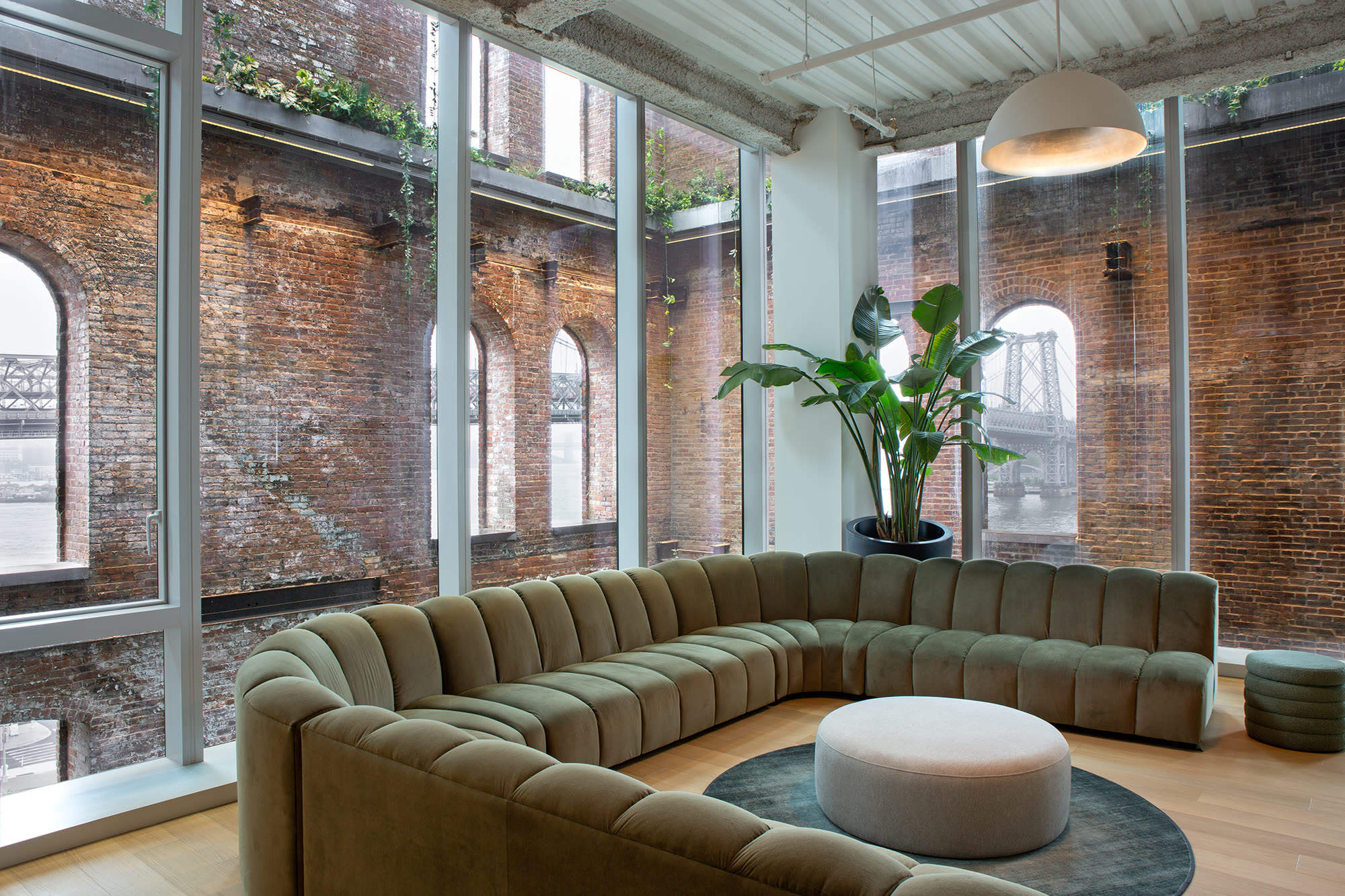
coDesign at Domino. The finished lounge, set against the refinery's preserved brick arches, with the Williamsburg Bridge through the glass.
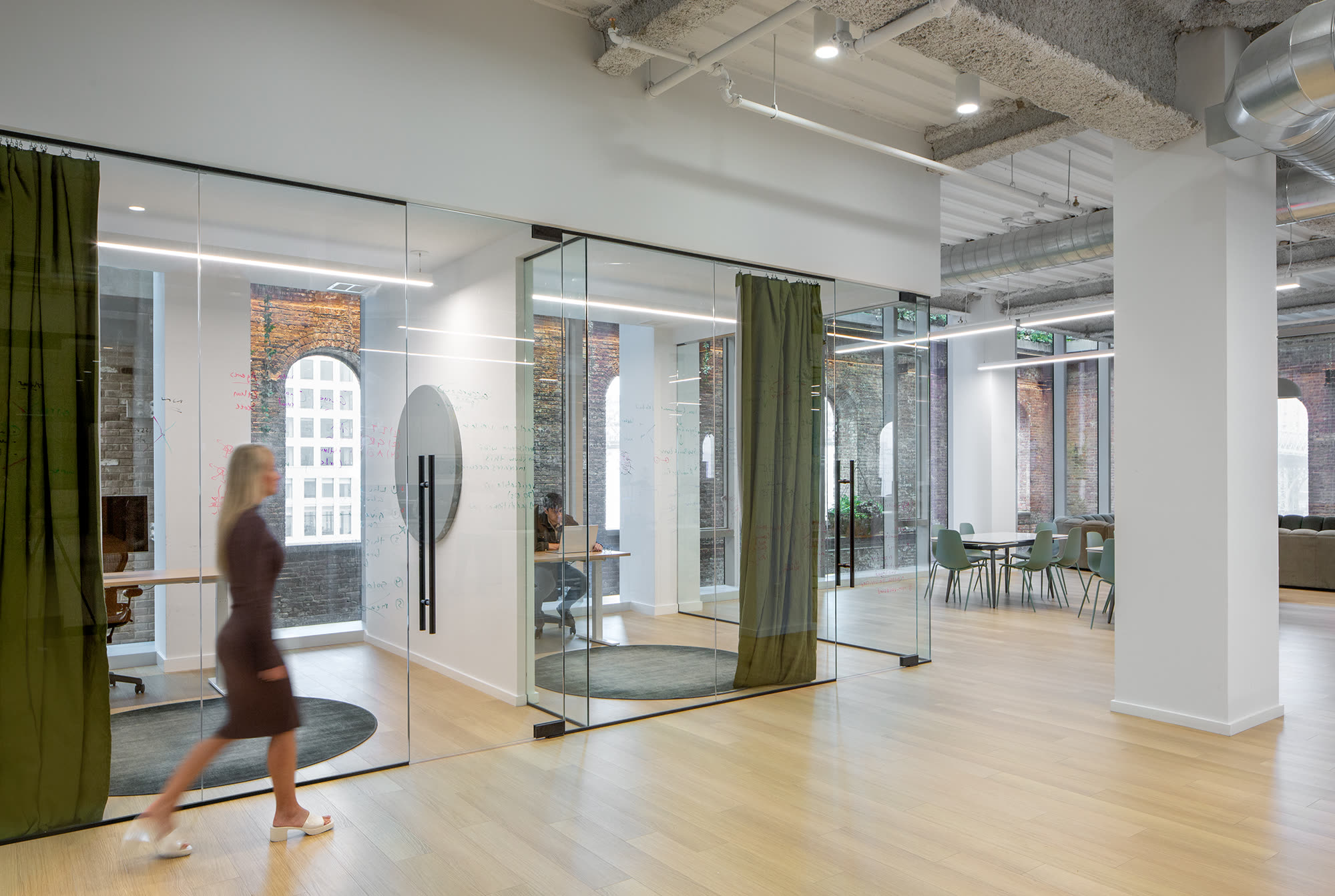
Glass rooms against the original brick, the condition that defines the job.
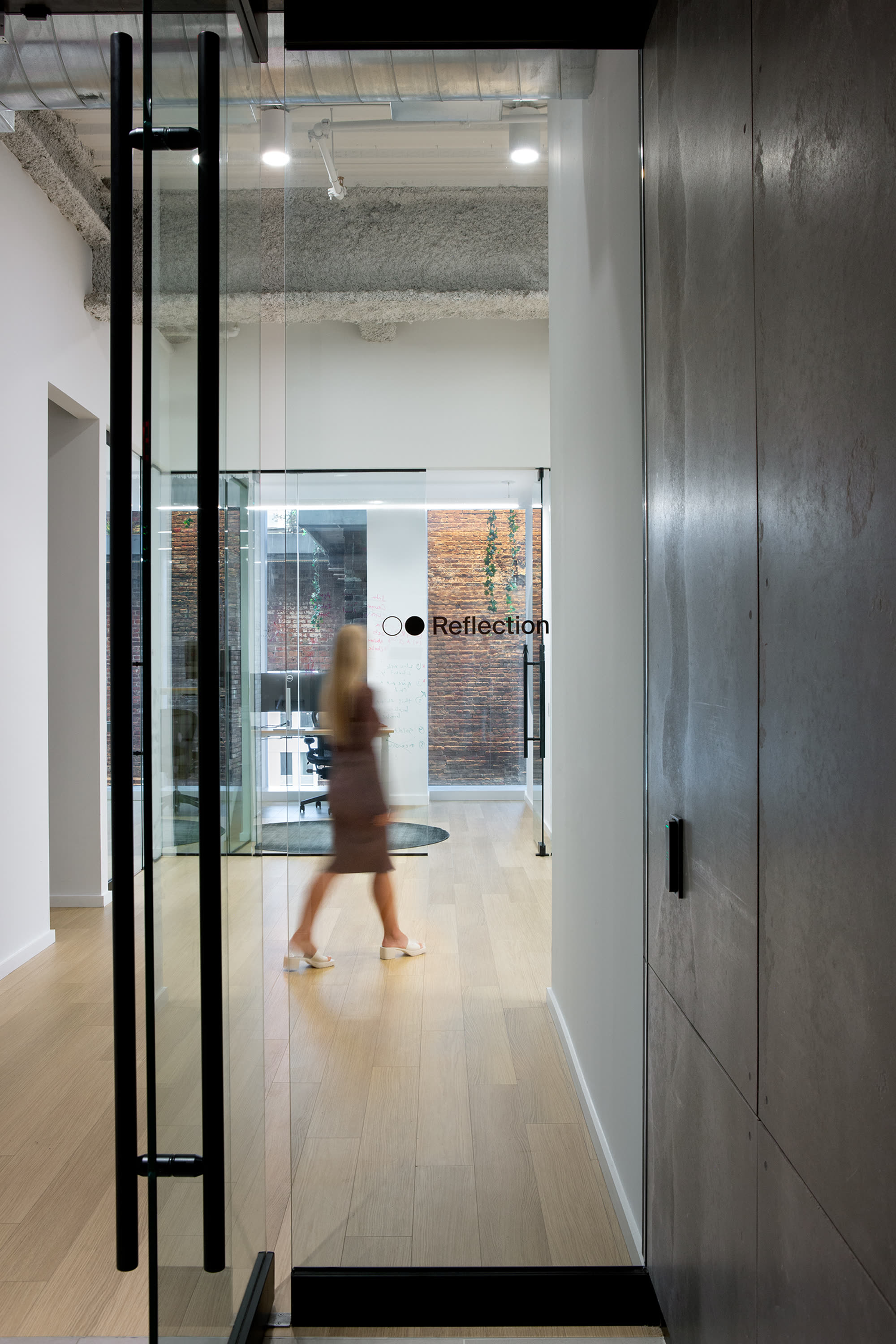
A modern workplace fitted into a landmark, in daylight.
04 — The coasts, and beyond
The idea is now
everywhere.
Detroit is the most dramatic recent example, not the origin. The same conviction has been reshaping cities for years, and nowhere more visibly than on the West Coast. The San Francisco Ferry Building, reopened as a public market back in 2003, had already survived two earthquakes, a double-decker freeway slammed across its front and serious plans to demolish it, before its turn-of-the-century nave was given back to the public and the Embarcadero handed back to the water. It is now one of the most-loved rooms in the city. Down the coast, the garment factories and warehouses of downtown Los Angeles have become its most sought-after addresses, with Omgivning and a generation of reuse architects turning industrial bones into offices, markets and homes, and the old Ford assembly plant in Hollywood reborn as a music-company headquarters.
The argument underneath all of it is the one owners everywhere are catching up to. The greenest building, and very often the most valuable, is the one already standing. Reuse keeps the embodied carbon of the original structure, delivers a character that cannot be manufactured, and, with the right team, can reach a finished, occupiable building faster than starting over. The same logic is rewriting other markets too. In Texas, San Antonio's 1880s Pearl Brewery became a beloved district anchored by Hotel Emma, and Houston's vast Barbara Jordan Post Office reopened as OMA's POST Houston. Different cities, different buildings, one idea.
05 — coDesign
We are built for the
significant ones.
Detroit, Brooklyn and the coasts are not really separate stories. They are one. The architecture is different every time, and the design firms deserve every bit of the credit they get. But the reason these projects stand up, on time, on budget, and worthy of the buildings they inhabit, is almost always the same: a specialist team was assembled around a specific asset and did the hard, invisible work of preconstruction before anyone started to build.
That is the work coDesign is built for. We use preconstruction to analyze a building before anyone commits to it, to find what the drawings never showed, and to turn an existing asset into the most valuable version of itself. Reading a structure nobody documented. Pricing ambition while it can still be chosen. Protecting what makes a building matter and going hard at everything else. We do it across corporate workplaces, hospitality, and the repositioning of signature assets, the historic ones included, and we have done it inside a landmark as demanding as the Domino refinery.
The most valuable building is often the one already standing. We exist to analyze, de-risk and deliver the investments that turn it into something greater, the monumental, complex, once-in-a-generation projects. For us, that is not the exception. It is the point.
Media & credits
- Hero film, Michigan Central at night, Domino and Ferry Building footage, and the Domino project photography — coDesign
- The Restoration of Michigan Central Station — The Wheel Network, YouTube
- A tour of Detroit's historic, redeveloped Book Tower — WXYZ-TV Detroit, Channel 7, YouTube
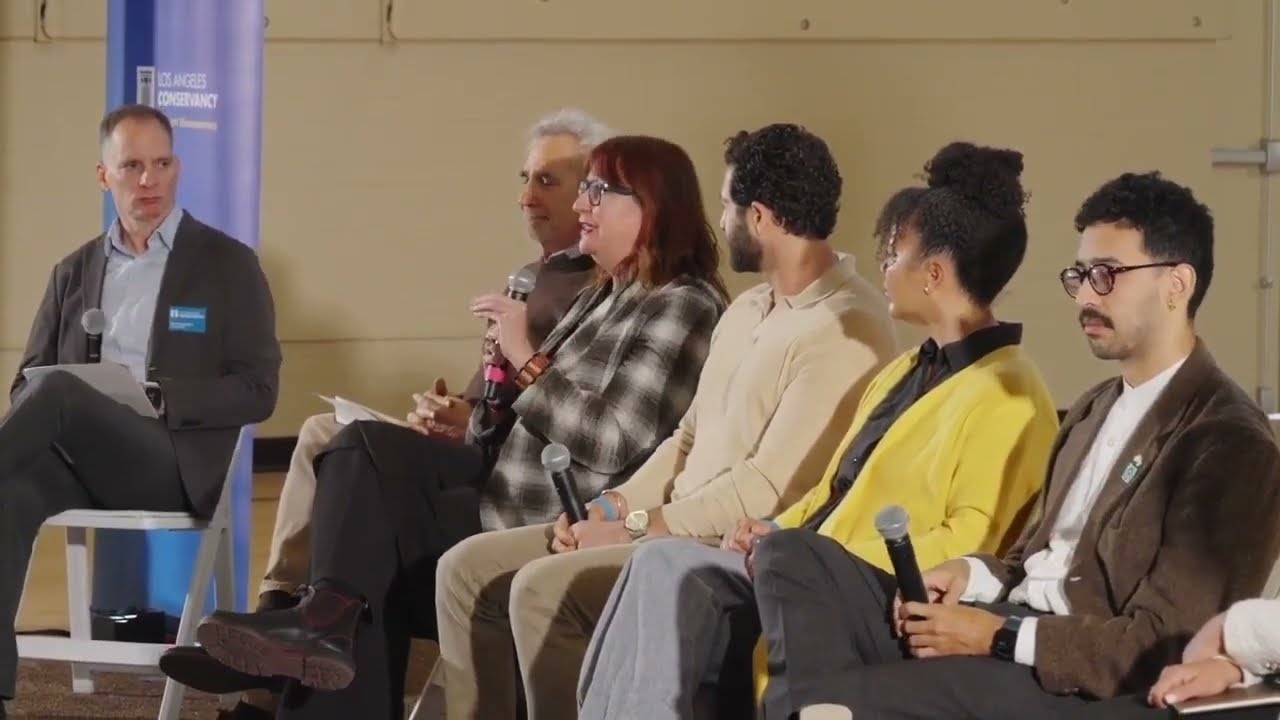
- Why Adaptive Reuse was Successful in Los Angeles — Omgivning, YouTube
The three YouTube clips are embedded from the publishers' own channels and play on their platform; all rights remain with the credited creators. All other footage and photography is coDesign's own. coDesign is not affiliated with the projects, owners or design firms named here except where stated; they are cited as the public record of the work.